The New York Times — Sunday, April 11, 1999 — Making It Work
Help for the Chutzpah-Challenged
Shy New Yorkers Turn to Support Groups, If They Get the Courage to Show Up
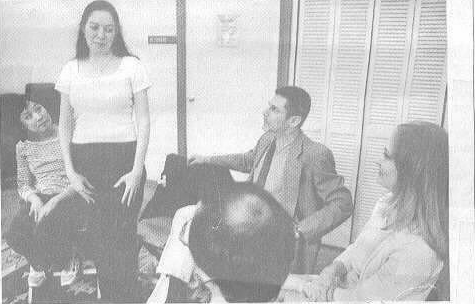
Barry Greenblatt, a 911 supervisor for the New York Police Department, was standing in front of a class of eight, somewhat anxiously describing a science show he had watched on television the night before. He fidgeted momentarily and stuttered slightly. Then Mr. Greenblatt was asked to walk across the room in front of everyone.
“How did that feel?” asked the instructor, Charles di Cagno.
“I’d say it was a 4,” Mr. Greenblatt said. That’s 4 on a scale of 1 to 10, with 10 signifying the most intense feelings of social anxiety. But the other participants in this Upper West Side support group said he didn’t seem all that nervous.
“I’ve been pretty shy all my life,” said Mr. Greenblatt, 39, who grew up in Queens. “It’s hard for me to get dates and to be assertive on the job. I have to force myself not to be overly polite.”
In a city famous for brusque waiters, crude cabbies and Howard Stern, there also exists the chutzpah-challenged. “Shy people are just as common in New York as in any other place; you just might not notice them as much,” said Dr. Diane Britton, a Manhattan psychologist, whose ad in The New York Observer says she offers counseling on “shyness, conversation skills and dealing with aggressive New Yorkers.”
Some 50 percent of Americans consider themselves chronically shy, according to the Shyness Research Institute at Indiana University Southeast. And New York appears to have its fair share, judging from the various programs in the city that offer solace and schooling on the subject.
At the Learning Annex, an adult education center in Manhattan, one of the most popular classes is called “Are You Shy? Is It Holding You Back? How to Live Successfully in an Aggressive World.” Another class being offered is “Dating Strategies for Shy New York Singles.” There are at least three support groups for shy city dwellers, and therapists who specialize in treating shyness and social anxiety.
“In New York you’ve got so much coming at you,” said Jonathan Berent, director of the Center for Shyness and Social Therapy in Great Neck, N.Y., and a psychotherapist who treats some shy people who live in the city. “It’s more fast-paced and intense, so it can be difficult for shy people.”
Mr. Berent, the author of Beyond Shyness: How to Conquer Social Anxieties (Simon & Schuster, 1994), said that in New York, it is easier for shy people to become anonymous. “There are more people to blend in with, more places to hide,” he said.
The catch for shyness support groups, of course, is persuading the shy to attend. Mr. di Cagno, who has counseled shy New Yorkers for eight years, said, “I get a lot of calls from people who are interested, but they’re afraid to show up, and many drop out after one or two sessions.”
He said that 75 percent of his clients were women. “Men think if they admit they’re shy, they’re admitting weakness,” Mr. di Cagno said. His workshop consists of 10 weekly sessions and offers what he calls “a supportive atmosphere and manageable steps.” The steps include such things as standing and responding to simple questions from the group or describing a pet using gestures and movement.
Mr. di Cagno’s students also do mock job interviews in front of one another. According to therapists who treat shy people, job interviews and work-related presentations are often big stumbling blocks.
“Especially in a city like New York, where the job market is so competitive and it’s often difficult to move up in a job, interviewing and presentation skills can be crucial,” said Dr. Bernardo Carducci, who teaches the courses for the shy at the Learning Annex and is the author of Shyness: A Bold New Approach (HarperCollins, 1999). “The shy are often at a disadvantage.” In extreme cases, Dr. Carducci said, people remain unemployed for years because they are afraid to go on a job interview.